
Hello! Welcome to the official website of Changte New Materials Co., Ltd.!
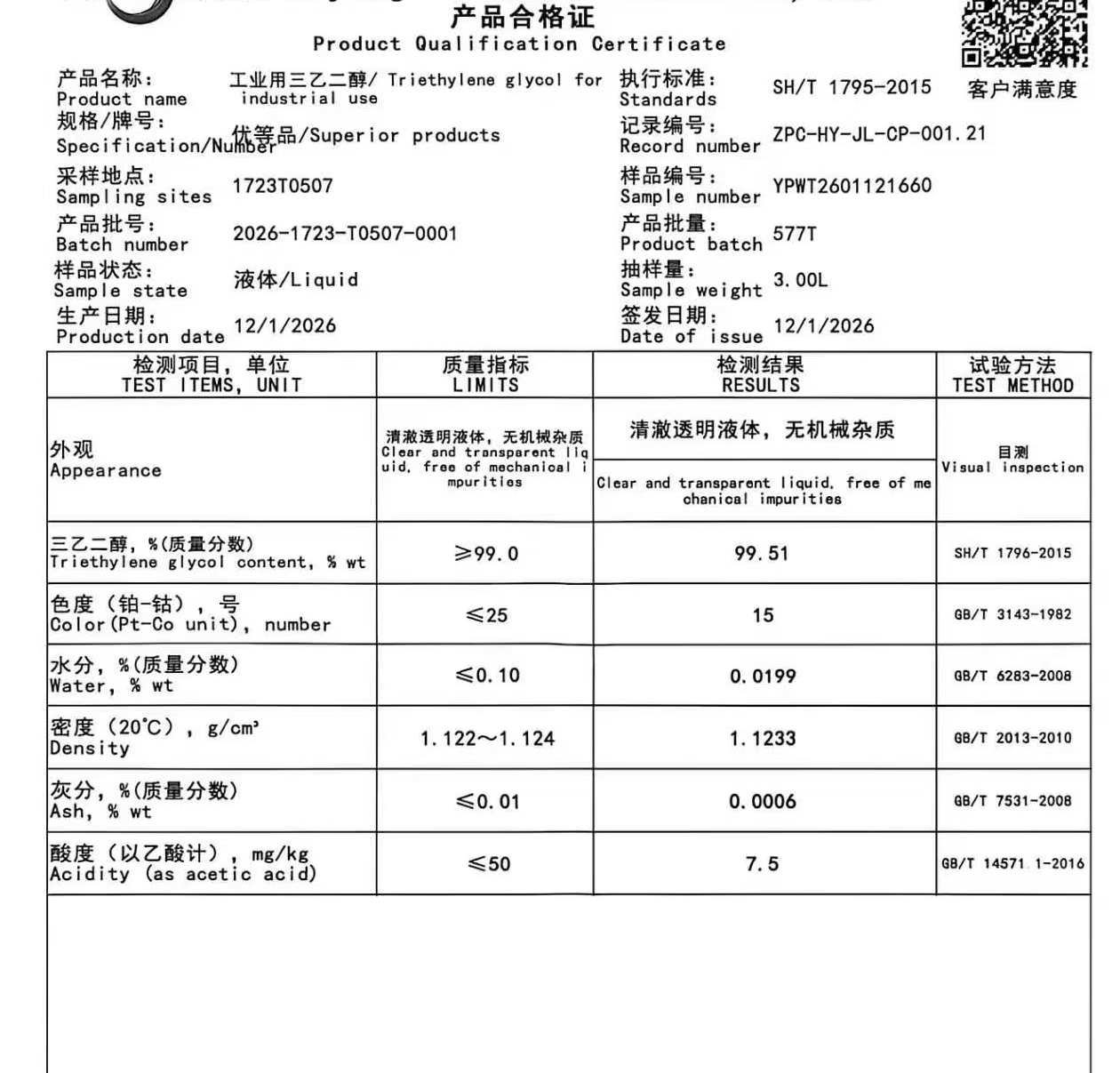
Product Name : Tnethylene Glycol
Abbreviation : TEG
CAS No. : 112-27-6
HS Code : 2909499000
Triethylene Glycol (TEG) is an important organic chemical product with the CAS No. 112-27-6 and HS Code 2909499000. It is a colorless, transparent, hygroscopic liquid with low volatility, high boiling point, good water solubility, and excellent moisture absorption performance. Due to its stable chemical properties and strong dehydrating ability, Triethylene Glycol is widely used in natural gas dehydration, air treatment systems, solvents, plasticizers, resins, coatings, inks, and various industrial chemical applications.
Triethylene Glycol is widely used as a dehydrating agent in the natural gas industry. It can effectively absorb water vapor from natural gas and other gas streams, helping to reduce moisture content, prevent pipeline corrosion, avoid hydrate formation, and improve the safety and stability of gas transportation and processing systems. Because of its strong hygroscopic property and good regeneration performance, TEG is one of the commonly used glycol products in gas dehydration units.
In addition to gas dehydration, Triethylene Glycol can also be used as a solvent, plasticizer, and chemical intermediate. It is applied in the production of resins, plasticizers, polyurethane products, polyester materials, coatings, inks, adhesives, and functional fluids. Its good compatibility with water and many organic compounds makes it suitable for industrial formulations that require stable dissolution, moisture control, and low volatility.
Triethylene Glycol is also used in air conditioning systems, heat transfer fluids, brake fluids, hydraulic fluids, and selected air treatment applications. Its excellent moisture absorption ability and thermal stability make it suitable for systems where humidity control, temperature stability, and long-term performance are required. In some applications, TEG may also be used as a component in disinfectant or air-sanitizing formulations, depending on the required product grade and regulatory standards.
The product should be stored in a cool, dry, and well-ventilated warehouse. Keep the container tightly closed and avoid exposure to heat, open flames, direct sunlight, and strong oxidizing agents. During handling, operators should wear suitable protective equipment and avoid direct contact with skin, eyes, and clothing. Proper storage and transportation conditions help maintain product quality and stability.
Packaging can be arranged according to customer requirements, including drums, IBC tanks, ISO tanks, flexitanks, or bulk shipment. We provide stable product supply, reliable quality control, flexible packaging solutions, professional export documentation support, and efficient logistics services to meet the purchasing needs of global industrial customers.